Merit and Visibility Have to Work Together
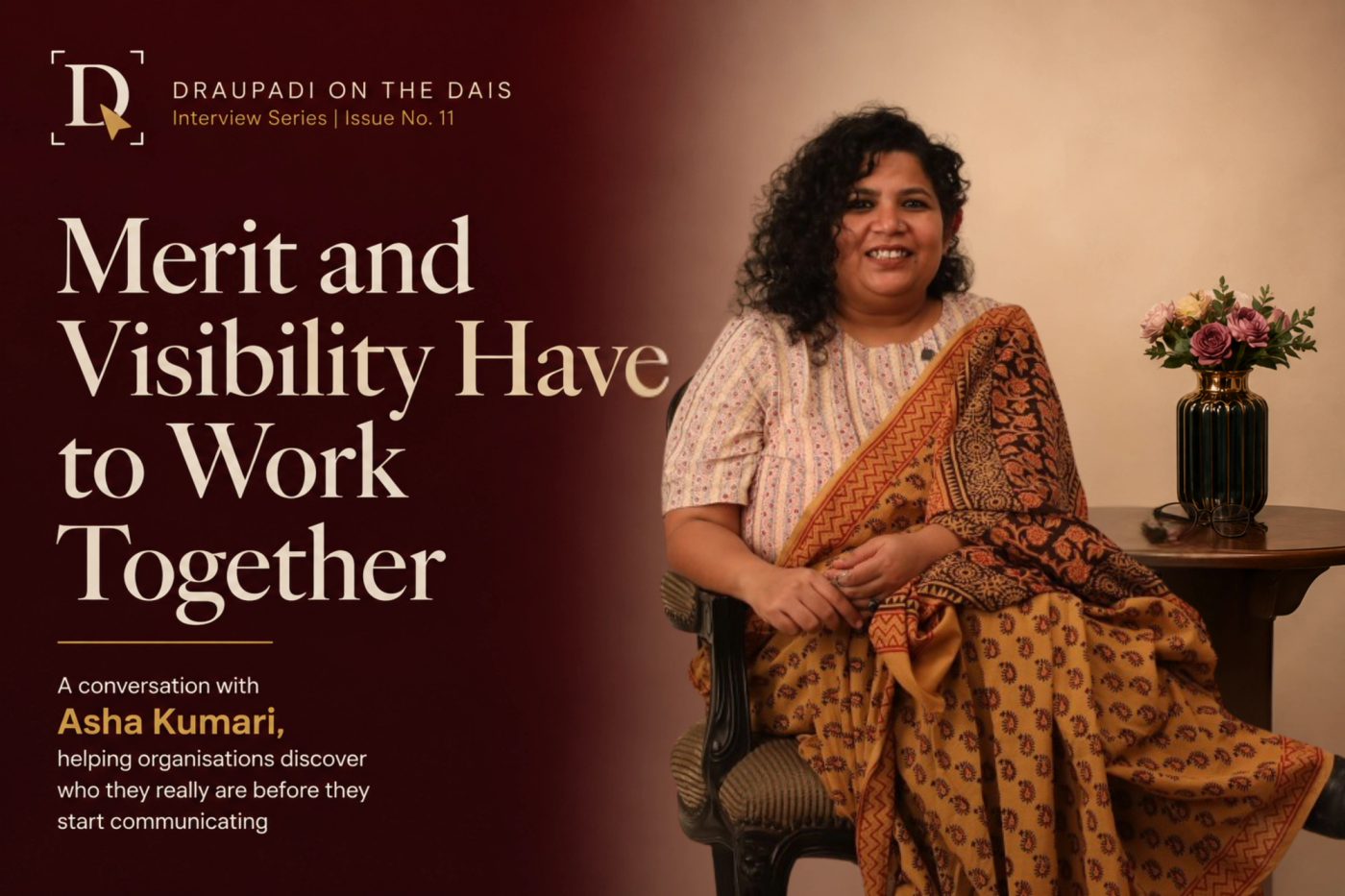
Asha Kumari is Head of Communications and Branding at the Indian Institute of Art and Design and UDIT. Her career spans 17 years across fashion journalism, e-commerce content strategy, SEO, and institutional brand building, with roles at Images Multimedia Group and HomeShop18, and visiting faculty at NIFT Delhi for over 14 years.
The Least Visible Part of My Job, and the Part I’m Least Willing to Compromise On
Q1. There is usually work that happens with no name on it, no metric attached, and that most people around you probably do not notice. What is the most important thing you do that fits that description?
I think the most important thing I do is create a space where people feel safe enough to think honestly.
That sounds simple, but I’ve realised it’s some of the most invisible work I do. My team knows they can come to me when they’re stuck, overwhelmed, frustrated or simply unsure of themselves. Sometimes they need feedback, sometimes they need perspective, and sometimes they just need someone to listen without immediately trying to fix everything.
I don’t think leadership is only about making decisions or driving outcomes. It’s also about creating an environment where people feel respected, understood and not judged. When people don’t spend their energy protecting themselves, they do better work. They’re more willing to ask questions, admit mistakes, experiment and grow.
There’s no KPI for that, and no one really sees those conversations because they happen behind closed doors. But I genuinely believe a lot of the quality of our work comes from those moments. If my team feels supported, they’ll take better creative risks, collaborate more openly and become more confident over time.
It’s probably the least visible part of my job, but it’s also the part I’m least willing to compromise on.
Most Communication Problems Aren’t Actually Communication Problems
Q2. You are known for brand communications and institutional storytelling, but there is often a project underneath the project, something you are building that does not have a job title attached to it. What is it?
I think the project underneath all my projects is helping organisations discover who they really are before they start communicating.
I’ve realised that most communication problems aren’t actually communication problems. They’re clarity problems. We jump straight to campaigns, content calendars, social media or PR, when the harder question is, “What do we actually stand for, and why should anyone care?”
Whether it’s building a university brand, working with founders or thinking about cultural institutions, I’m usually trying to uncover the story that’s already there but hasn’t been articulated yet. Once that becomes clear, everything else, campaigns, messaging, design, even marketing decisions, starts feeling much more intentional.
I don’t have a formal title for that work. Sometimes it looks like brand strategy, sometimes editorial thinking, sometimes just asking uncomfortable questions in meetings until everyone is aligned. But it’s the work I enjoy the most because it creates a foundation that lasts much longer than any single campaign.
Professional Success and Personal Fulfilment Don’t Have to Compete
Q3. Most careers have a decision that looked wrong from the outside and turned out to be exactly right. What was yours, and what did it teach you that no formal experience could have?
One decision that probably looked wrong from the outside was choosing not to move cities at different points in my career.
There were opportunities where relocating might have accelerated my career or given me a first-mover advantage. But I chose to stay because being close to my family mattered to me. I’ve been fortunate to have an unconventional but deeply supportive family, and I never saw them as something I had to sacrifice in order to succeed.
That choice also meant I had to build my career differently. Instead of chasing the most obvious path, I kept expanding my skills. I moved across industries, kept learning, took self-directed breaks to explore new ideas, and was comfortable starting from scratch when something genuinely interested me. Those weren’t pauses in my career, they became part of my education.
What that taught me is that professional success and personal fulfilment don’t have to compete with each other. In fact, I think they strengthen each other. When you’re content with the life you’re building outside of work, you bring a different kind of perspective to work itself. You’re less driven by comparison, ego or insecurity, and more by curiosity, purpose and the quality of what you’re creating.
Looking back, I don’t regret that decision for a moment. It shaped not just the professional I’ve become, but the person I became first. And I think the latter has made the former much better.
Merit and Visibility Have to Work Together
Q4. Have you ever watched someone with a thinner CV get called into a room you should have been in? What did that teach you about how discovery actually works?
Yes, many times.
I’ve spent most of my career building brands and institutions rather than building my own public profile. A lot of the work I’m most proud of lives under someone else’s logo. That’s the nature of in-house roles—you help make the organisation visible, not necessarily yourself.
So yes, there have been moments when I’ve seen someone with a shorter CV or less experience get invited into conversations I thought I could have contributed to.
Earlier, I used to think discovery was purely merit-based. That if you kept doing good work, the right people would eventually find you. I don’t believe that anymore.
I still believe good work is essential, but I’ve realised it also has to be visible, documented and shared. People can’t value work they don’t know exists.
That realisation hasn’t made me cynical; it’s made me more intentional. I’ve started documenting my thinking, writing more, building a body of work under my own name and becoming more comfortable talking about what I do, not because I need attention, but because ideas need a way to travel.
For me, the lesson wasn’t that merit doesn’t matter. It was that merit and visibility have to work together. One without the other leaves too much to chance.
Present in the Right Places When the Right People Come Looking
Q5. There is a version of visibility that requires performance, constant output, constant presence. And there is another version that is just being findable in the right places. How do you think about the difference?
Experience also made me think differently about visibility itself.
I think there are two very different kinds of visibility. One is built on constant performance always being present, always producing, always staying in people’s line of sight. There’s nothing wrong with it, and for some people it works really well. It’s just not the kind of visibility I’m trying to build.
However, I don’t think visibility should become a full-time job in itself. If it starts taking more energy than the work you’re trying to make visible, something feels off.
The other kind is quieter. It’s about being discoverable because your work, your thinking and your point of view exist in the world in a way that’s easy to find and easy to understand. Someone hears your name, looks you up, and gets a genuine sense of who you are and what you bring.
That’s the version I’m much more interested in.
I don’t want to become visible by constantly asking for attention. I’d rather become visible because I’ve been intentional about documenting my work, sharing what I’ve learned, and leaving behind enough evidence that the right opportunities can find me.
For me, visibility isn’t about staying in front of everyone. It’s about being present in the right places when the right people come looking.
Quiet Confidence
Q6. Who were the women you watched build careers before you? What did they teach you that they probably did not know they were teaching?
Almost all of my most formative bosses have been women, and I’ve often found myself drawn to working with women leaders.
What has always fascinated me is the way they seemed to carry enormous responsibility without needing to constantly announce it. There was a quiet confidence to the way they led. They could be decisive without being intimidating, ambitious without making everything about themselves, and deeply invested in the people around them while still holding incredibly high standards.
As I grew older, I also became more aware of the context they were operating in. I watched brilliant women have to prove themselves more than once, have their authority questioned in ways their male counterparts often weren’t, and recover from setbacks that had very little to do with the quality of their work. What stayed with me wasn’t the unfairness of it, although I certainly noticed it, it was the resilience with which they kept showing up.
I Finally Stopped Waiting for Someone Else to Define the Next Chapter
Q7. Five years from now, you are in a conversation with someone whose judgment you trust. Not a performance review, just an honest conversation. What do you want to be able to say about this period?
I hope I can say that this was the period when I finally stopped waiting for someone else to define the next chapter of my career.
I’ve spent many years building institutions, teams and brands that I’m genuinely proud of. But somewhere along the way, I realised I had also become very comfortable helping other people tell their stories while keeping my own in the background.
I think this is the phase where I’m trying to change that, not by becoming a different person, but by becoming a little more visible, a little more intentional and a little more willing to trust my own point of view.
Five years from now, I don’t want to look back and measure this period only by titles, clients or promotions. I want to be able to say that I backed myself. That I was willing to take a few uncomfortable risks, build something that reflected how I think, and see where it could go.
Maybe it becomes a consultancy. Maybe it becomes something I can’t predict today. That part matters less to me than knowing I had the courage to begin.
I think I’d be disappointed if, five years from now, I realised I had spent this time choosing certainty over curiosity. I’d much rather be able to say that I explored, experimented, learned, and built something that felt deeply my own.
Asha Kumari is Head of Communications and Branding at IIAD and UDIT. This interview was conducted as part of the Draupadi on the Dais Interview Series.