We’re Not Providing Access, We’re Just Performing It
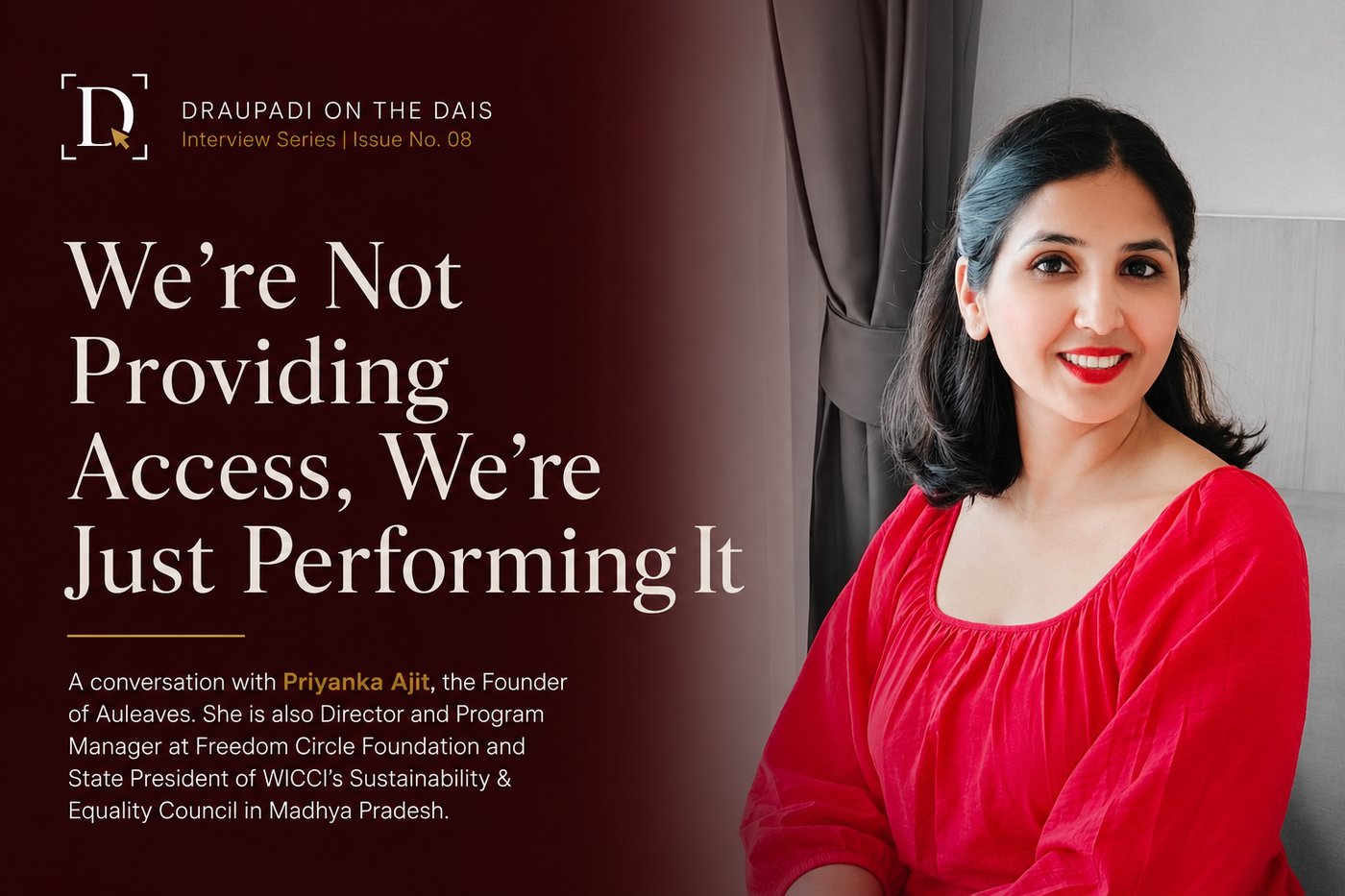
Priyanka Ajit is the Founder of Auleaves, building menstrual health adoption infrastructure for India through structured behaviour-change programmes deployed via CSR partnerships and institutional channels. She also serves as Director and Program Manager at Freedom Circle Foundation and State President of WICCI’s Sustainability & Equality Council in Madhya Pradesh.
Trust Is Earned Through Consistency, Not Hype
Q1. Most careers have a decision that looked wrong from the outside and turned out to be exactly right. What was yours, and what did it teach you that no formal experience could have?
Most career paths include a decision that seemed questionable at the time but later proved essential. For me, it was choosing sustainable, deliberate growth over rapid scaling. While others pushed for aggressive fundraising and widespread visibility, I focused on building solid infrastructure and refining our work carefully. At the time, this drew criticism on why do you want to invest in slow progress when you could chase fast success? But this choice taught me something no formal training could: in fields like health and sustainability, trust is earned through consistency and not hype. When your mission revolves around people’s well-being, there’s no shortcut. You can’t rely on clever messaging, you have to deliver real, lasting value.
The Quiet Bridge That Makes Difficult Topics Feel Safe
Q2. You are known for menstrual health adoption infrastructure, but there is often a project underneath the project, something you are building that does not have a job title attached to it. What is it?
Though I’m recognized for advancing menstrual health infrastructure, there’s an unspoken part of my work that doesn’t appear in any title. It’s about navigating the discomfort that comes before change. Walking into a room where people avoid the topic where laughter feels nervous and silence speaks louder than words. That means the real task isn’t presenting solutions, but disarming hesitation. My role is to be so grounded, so matter-of-fact, that tension eases without anyone noticing. I aim to shift the conversation from “this is awkward” to “this is normal.” The real work is being the quiet bridge that makes difficult topics feel safe to discuss.
We're Not Providing Access, We're Just Performing It
Q3. What is the most widely held belief in your field that you quietly, or not so quietly, disagree with?
One widely accepted idea in this field is that access means distribution. People assume that because pads or cups are available somewhere, the problem is solved. But handing out products once doesn’t equal lasting access. A donation drive makes for a good photo, but what happens afterward? If a school has a vending machine but no water, privacy, or waste system, the product becomes meaningless. Real access isn’t about dropping off supplies, it’s about creating systems that last. It’s reliable supply chains, proper disposal, dignity, and daily functionality. Until we build that full ecosystem, we’re not providing access, we’re just performing it.
Impact, Not Exposure, Defines Progress
Q4. There is a version of visibility that requires performance, constant output, constant presence. And there is another version that is just being findable in the right places. How do you think about the difference?
Visibility can mean constant presence like you have to be mostly speaking, posting, appearing. Or it can mean being present where it matters, even if quietly. I believe meaningful work shouldn’t be sacrificed for visibility. There are times to be in public giving talks, writing, sharing stories. But the most important work happens behind the scenes: in factories, classrooms, villages, meetings. In those moments, visibility adds nothing. I’d rather operate unseen while driving real impact than be seen everywhere with little to show. Impact, not exposure, defines progress.
Switch Between Boardroom Confidence and Sitting Barefoot on the Floor of a Rural School
Q5. Building a career in India, in the field you are in, carries a specific set of invisible requirements that are not in any job description. What are some of them?
Working in this field in India comes with unwritten demands that no job description mentions. The most endless administrative delays and learning to read silence when officials don’t say no, but don’t say yes either. This work sits at the crossroads of health, policy, and grassroots action, which means navigating layers: government offices, local leaders, NGOs, communities. No one warns you about the hours spent waiting for approvals, or the frustration of translating high-level policies for people with no formal education. You must switch effortlessly between boardroom confidence and sitting barefoot on the floor of a rural school. Success here requires deep cultural awareness and relentless patience balancing competing priorities, often contradictory, without burning out. It’s not for everyone.
My Life Is Loud and Crazy at the Moment
Q6. Right now, not in your bio but in your actual life, who are you across the different things you are doing?
Today I am living in a state of constant code-switching between a visionary builder and a micro-solver, trying not to drown in the process. My brain is scattered on a hundred different tasks at once today. I am an entrepreneur, trying to solve supply chains and logistics of our sustainable brand, and I am a community member, trying to figure out how to build our female ambassadorship program during the calls. I am a mentor, trying to teach our master ambassadors to lead their own channel. But at the same time, I am also just one human being, desperately trying to balance all of the above without losing my sanity. I think I am doing pretty well. I’ve accepted that my life is loud and crazy at the moment, and I cannot think of a better way to be.
Stop Valuing Titles and Start Honouring Practical Wisdom
Q7. If you could change one thing about how your field identifies, develops, or elevates expertise, what would it be?
If I could change one thing about how expertise is recognized in this field, it would be shifting focus from academic credentials and polished presentations to real-world experience. Too often, we elevate those who speak well in conferences or produce elegant reports, even when their ideas fall apart on the ground. True expertise comes from people who’ve kept supply lines running during floods, negotiated cultural barriers in remote areas, or built systems with almost no resources. Lasting change is driven by doers, not just theorists. We need to stop valuing titles and start honoring the practical wisdom of those who’ve faced challenges head-on and learned exactly where and why things break and how to fix them.
Priyanka Ajit is Founder of Auleaves. This interview was conducted as part of the Draupadi on the Dais Interview Series.