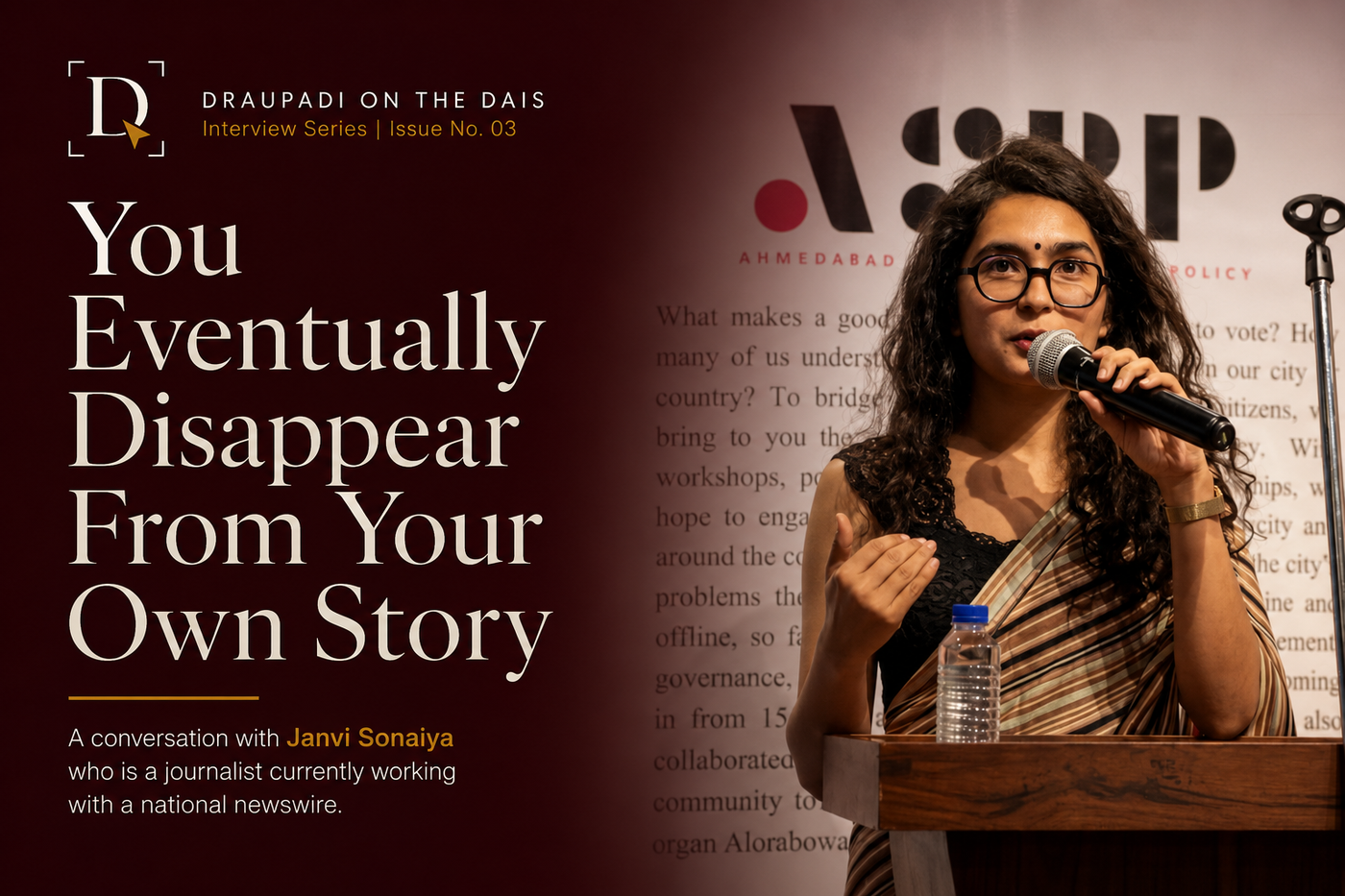
Janvi Sonaiya is a journalist based in Gujarat, currently working with a national newswire. She also writes Geopolitics & Beyond. She has spent a decade in features journalism across DNA, Ahmedabad Mirror (Times of India Group), Divya Bhaskar, and Virago Media, covering films, theatre, music, health, lifestyle, and art.
I Want Them to Matter
Q1. When did the work start feeling like yours, not just something you were doing?
The work started feeling like mine when I stopped measuring success by bylines and started measuring it by impact. Early in my career, I wanted my stories to be published. Today, I want them to matter. There is a different kind of satisfaction in finding a story nobody else is looking at, speaking to people who are usually ignored, and helping readers understand a reality they may never encounter themselves. That’s when journalism stopped feeling like a job and started feeling like a responsibility.
Building Trust
Q2. There is usually work that happens with no name on it, no metric attached, and that most people around you probably do not notice. What is the most important thing you do that fits that description?
Building trust. Journalism is often portrayed as breaking news and asking tough questions, but a large part of the job is simply showing up consistently. Calling people when you don’t need a quote. Checking in after the story is over. Listening more than talking. Sources share information because they trust you, not because they owe you anything. That trust takes years to build and can be lost in a moment. It doesn’t appear on a CV, but it is the foundation of almost everything I do.
Good Work Needs an Audience
Q3. Have you ever watched someone with a thinner CV get called into a room you should have been in? What did that teach you about how discovery actually works?
Of course. Most professionals have. Early on, it felt unfair. Later, I realised that careers are not built on merit alone. Visibility, relationships, timing and perception all play a role. Discovery is rarely a perfect system. The lesson for me was not to become cynical about it, but to understand that good work needs an audience. You cannot assume people will find you. You have to make your work visible while making sure visibility never becomes more important than the work itself.
Discoverable, Not Omnipresent
Q4. There is a version of visibility that requires performance, constant output, constant presence. And there is another version that is just being findable in the right places. How do you think about the difference?
I think we live in a culture that often confuses visibility with value. Constant posting can make someone visible, but it doesn’t necessarily make them credible. I have always been more interested in being discoverable than being omnipresent. I want people to find my work when they are looking for someone who understands a subject, not because I happened to dominate their feed that day. Visibility gets attention. Credibility earns trust. The latter takes much longer to build.
No Version of a Successful Woman That Everyone Finds Comfortable
Q5. There is a particular way ambitious women in India are expected to be visible: enough that people notice, not so much that people are uncomfortable. How have you navigated that?
For a long time, women are taught to calibrate themselves. Be ambitious, but make sure nobody mistakes it for arrogance. At some point, I stopped trying to solve that equation. I realised there is no version of a successful woman that everyone finds comfortable. Today, I focus less on managing perceptions and more on doing work I believe in. If you spend your life trying to fit into other people’s comfort zones, you eventually disappear from your own story.
Confidence by Example
Q6. Who were the women you watched build careers before you? What did they teach you that they probably did not know they were teaching?
I have been fortunate to work with some remarkable women leaders in journalism. They taught me something very simple but very powerful: don’t apologise for taking up intellectual space. I watched them walk into press conferences, challenge assumptions, ask difficult questions and stand by their decisions. What they probably didn’t realise is that they were teaching confidence by example. Not the loud kind, but the quiet confidence that comes from knowing your work, trusting your judgement and not shrinking yourself to make others comfortable.
Give Journalists More Time
Q7. If you could change one thing about how your field identifies, develops, or elevates expertise, what would it be?
I would give journalists more time. Journalism today rewards speed, volume and constant output. But expertise is built through patience, reading, reporting and fact-checking. Many journalists are capable of much deeper work than the system currently allows. Low salaries, shrinking newsrooms and relentless deadlines often push people toward quantity over quality. If we genuinely value expertise, we need to create conditions where journalists have the time and resources to develop it.
Janvi Sonaiya is a journalist based in Gujarat. This interview was conducted as part of the Draupadi on the Dais Interview Series. This interview was conducted as part of the Draupadi on the Dais Interview Series.