From Scars to Systems
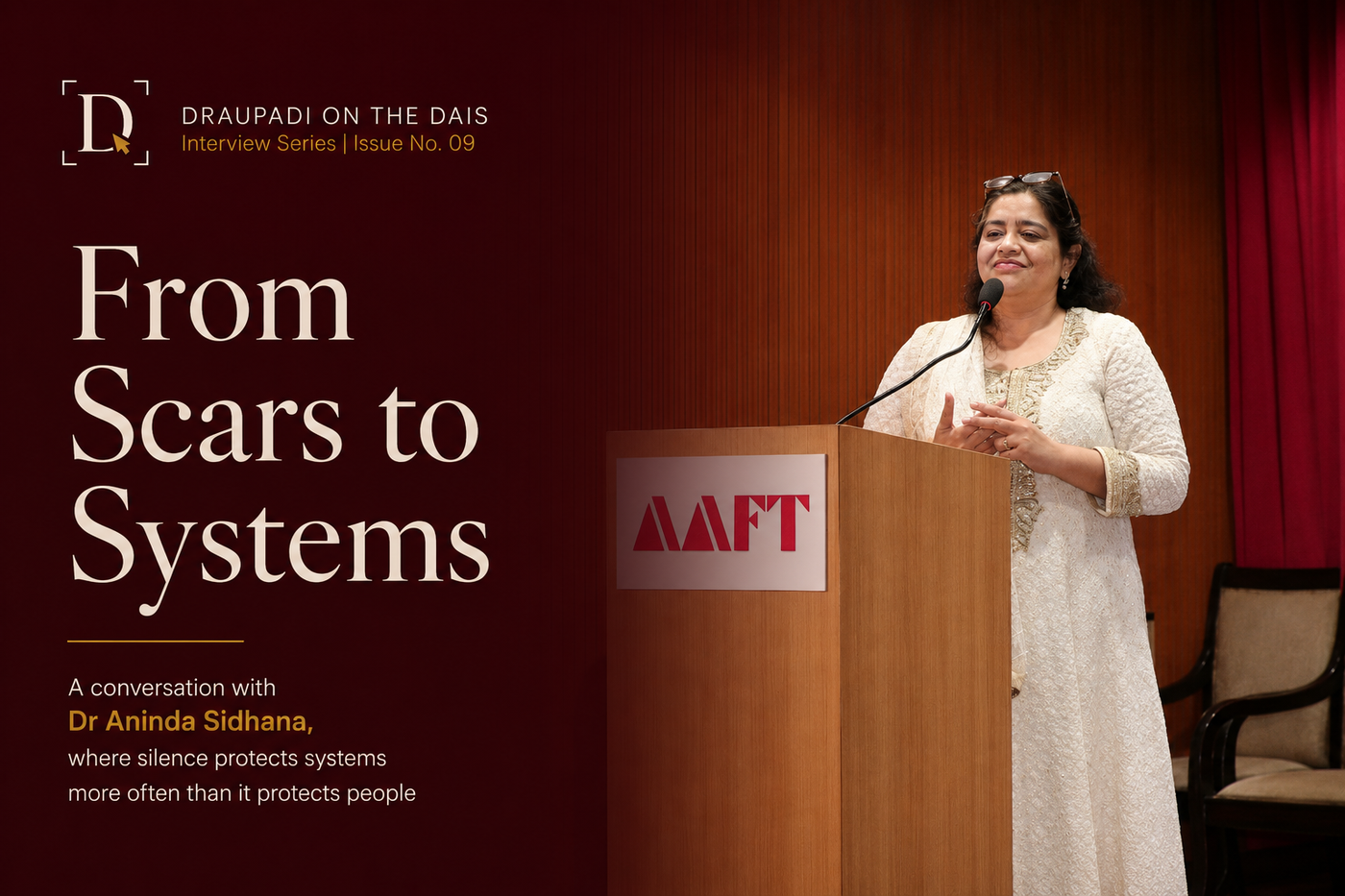
Dr Aninda Sidhana is an MD Psychiatrist, Assistant Professor, and Founder of multiple initiatives across psychosexual medicine, LGBTQ+ mental health, women’s wellness, and trauma-informed care. She serves as National President of WICCI’s Psychosocial and Mental Wellness Council, Convener of the Sexual Disorders Committee at the Indian Association of Private Psychiatry, and Assistant Editor of the Indian Journal of Psychological Medicine.
The Person Became the Centre
Q1. You have built real expertise in a specific area over a long time. When did the work start feeling like yours, not just something you were doing?
The work became mine when I stopped asking only, “What is the diagnosis?” and began asking, “What happened to this person? What have they never been allowed to say? What would help them feel human again?”
Medical training teaches us to recognise illness. Life taught me to recognise suffering.
Psychiatry gave me the language to understand the mind, but gradually I realised that no diagnosis can ever contain the full complexity of a human being. People never arrive as symptoms. They arrive carrying generations of silence, fractured relationships, invisible grief, inherited fears, cultural expectations, betrayal, shame, and hope.
That understanding became deeply personal. I know what it feels like when your voice is questioned. When your reality is doubted. When reclaiming your dignity becomes an act of survival.
The defining shift came when I consciously moved beyond medical paternalism towards a model built on listening, emotional safety, and shared humanity. Through The Dignity Dialogues, M.I.N.D.W.E.A.V.E., and my survivor-informed work, I stopped treating pathology as the centre of psychiatry.
The person became the centre. That was the moment psychiatry stopped being my profession, it became my purpose.
The Real Architecture of Healing
Q2. There is usually work that happens with no name on it, no metric attached, and that most people around you probably do not notice. What is the most important thing you do that fits that description?
The most important work I do rarely appears on a résumé.
It is staying emotionally present when another human being feels they are disappearing. It is hearing what is never spoken. It is noticing the silence after someone quietly says, “I’m fine.”
It is resisting the temptation to diagnose before listening, to advise before understanding, to fix before witnessing.
Sometimes the most therapeutic intervention is remarkably simple:
• “I believe you.”
• “What happened to you matters.”
• “You do not have to carry this alone.”
Healing often begins the moment people no longer have to defend the legitimacy of their pain. There are no awards for helping someone rediscover self-worth. No measurable KPI exists for the moment a person decides to stay alive, leave violence, ask for help, forgive themselves, or believe their future can still be different.
Those invisible moments are the real architecture of healing. Everything visible that I build stands upon that unseen foundation.
From Scars to Systems
Q3. You are known for psychiatry across psychosexual medicine, LGBTQ+ mental health, and women’s wellness. But there is often a project underneath the project. What is it?
Everything I do is really about building what I call an Empathy Economy—a society where empathy, emotional intelligence, psychological safety, and human dignity are treated not as soft virtues, but as essential public infrastructure.
Whether I am working in psychosexual medicine, women’s mental health, trauma-informed care, LGBTQ+ inclusion, media mental health, or gender justice, I am asking one fundamental question: How do we create environments where people finally feel safe enough to tell the truth about their inner lives?
For too long we have individualised suffering while ignoring the systems that produce it. We celebrate resilience while asking very little of the structures that create trauma. I do not believe healing should require people to endlessly adapt to environments that continue to diminish them. That is why my work moves from the individual to the structural—from scars to systems.
This journey also includes men. Gender justice cannot succeed by treating women only as victims and men only as perpetrators. Many boys are never taught the language of emotion. Many men inherit loneliness disguised as masculinity. Emotional literacy is not a women’s issue; it is a human issue. Shared liberation begins when empathy is no longer assigned a gender.
Silence Protects Systems More Often Than It Protects People
Q4. Being on DotD is a professional decision, not a self-promotion exercise. What made you decide to show up for yourself here?
Women are often taught to stand for everyone except themselves. We learn to nurture, to adjust, to forgive, to endure, to remain composed while quietly breaking. Then, when we finally tell our own story, it is mistaken for self-promotion.
I no longer believe reclaiming one’s voice is vanity. I believe it is responsibility.
I am not here to make pain perform. I am here because silence protects systems more often than it protects people.
Medicine has also inherited this silence. We have sometimes mistaken emotional distance for professionalism. My work has taught me something very different:
• Compassion does not weaken science.
• Humanity does not diminish expertise.
• Lived experience does not compete with evidence—it deepens it.
Standing on this dais means refusing to divide the psychiatrist from the woman, the scientist from the survivor, the professional from the human being. No woman should have to erase parts of herself in order to be considered credible.
Transformation Begins With Trust
Q5. Building a career in India, in the field you are in, carries a specific set of invisible requirements that are not in any job description. What are some of them?
Mental health work in India demands far more than clinical excellence. It demands cultural humility, emotional stamina, patience, and the ability to hear what people cannot yet say aloud.
Distress often disguises itself as headaches, marital conflict, religious guilt, family honour, sexual difficulties, or simply, “I will adjust.”
Working in psychosexual medicine, trauma, and women’s mental health means entering conversations that society often prefers to avoid. One must challenge harmful beliefs without humiliating those who inherited them—bridging science with culture, and honouring tradition without allowing tradition to justify suffering.
The greatest invisible skill is learning how to challenge systems while preserving human dignity. Transformation rarely begins with confrontation; it begins with trust.
I have never believed psychiatry belongs only inside hospitals. Its future will also be written in schools, films, newsrooms, technology, sports stadiums, boardrooms, and homes, everywhere human behaviour is shaped.
Offering Myself the Same Compassion
Q6. What does rest actually look like for you right now, not in theory but in practice?
Rest is something I continue to learn. For me, it is the deliberate practice of not abandoning myself while caring for everyone else.
Those who spend years surviving often become uncomfortable with stillness. Urgency becomes familiar. Boundaries feel guilty. Rest means listening before exhaustion speaks for me.
It means quiet mornings, nature, music, writing, reflection, mindfulness, and the daily practices within M.I.N.D.W.E.A.V.E. It means accepting that my value is not measured by constant availability.
Perhaps most importantly, it means offering myself the same compassion I offer every patient who walks into my room. Rest is not stepping away from purpose, it is returning to purpose without losing myself.
The True Measure of Expertise
Q7. If you could change one thing about how your field identifies, develops, or elevates expertise, what would it be?
I would redefine expertise itself.
Scientific knowledge, research, clinical skill, and academic excellence all matter enormously, but they are incomplete. A clinician can possess extraordinary credentials while leaving another human being feeling unseen.
Empathy should never remain an optional personality trait; it should become a core professional competency. We should train clinicians to recognise shame, power, trauma, relational safety, and human dignity, not simply symptoms, not simply diagnoses.
I would also create greater space for lived experience within leadership, not as spectacle or sentiment, but as knowledge. People who have lived through systems often understand what those systems fail to measure.
The future belongs to all three working together. The true measure of expertise is not how accurately we diagnose illness; it is whether another human being leaves feeling safer, less ashamed, more understood, and more capable of reclaiming their own life.
Dr Aninda Sidhana is an MD Psychiatrist and Founder. dranindasidhana.com. This interview was conducted as part of the Draupadi on the Dais Interview Series.