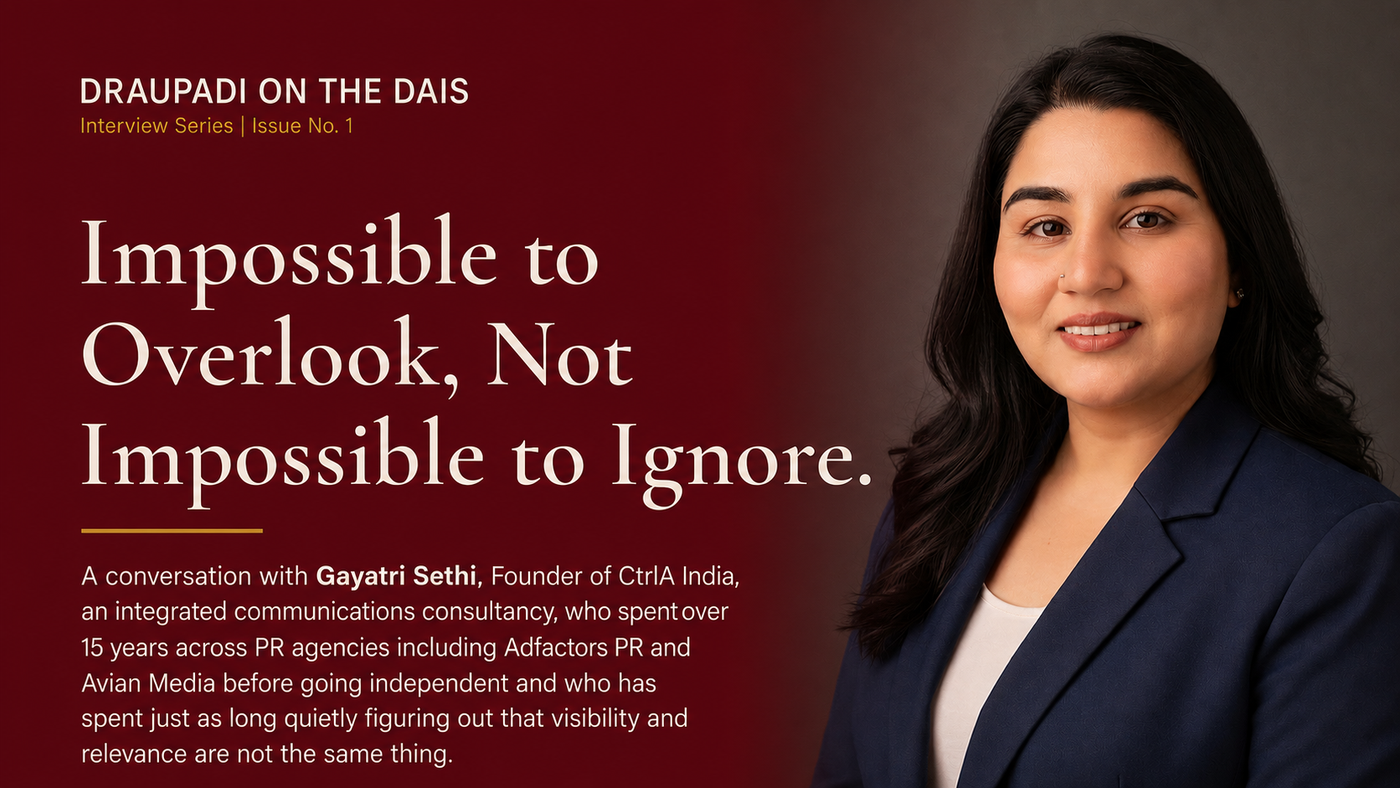
A conversation with Gayatri Sethi, Founder of CtrlA India, an integrated communications consultancy, who spent over 15 years across PR agencies including Adfactors PR and Avian Media before going independent, and who has spent just as long quietly figuring out that visibility and relevance are not the same thing.
Gayatri has built brand storytelling, media relations, and digital strategy careers for other people's companies for over a decade and a half. Then she built her own. Along the way she arrived at a working theory of the industry that most people in it never say out loud: that attention is not the same as affinity, that credibility is often transferred before it is earned, and that the loudest brand in the room is rarely the one people actually trust. She is also a founder and a mother, and she will tell you plainly that the second fact has sharpened her judgment about the first.
That combination, someone who has done the visible work and is now naming the invisible scaffolding underneath it, is what makes this conversation worth sitting with.
The Work With No Name On It
What is the most important thing you do that nobody notices?
Protecting perspective. Not strategy decks, not media plans, perspective. Campaigns come and go, media cycles move on, but relationships compound, trust compounds, and the ability to read people under pressure compounds. That, she says, is the real asset she has been building all along, long before anyone called it an asset.
Motherhood has only sharpened that filter. Children have a way of exposing what is actually important versus what is manufactured urgency, and some of her best business decisions have come precisely from not doing something everyone else was rushing to do.
Campaigns come and go. Media cycles move on. But relationships compound, trust compounds, and the ability to understand people under pressure compounds.
The asset was never the speed, it was the perspective you kept while everyone else was moving.
It is a quiet kind of confidence, the ability to watch an industry sprint toward urgency and choose not to sprint with it. Most career advice tells you to keep up. Hers is the opposite: the asset was never the speed, it was the perspective you kept while everyone else was moving.
Trust as Infrastructure, Not Output
You're known for PR and storytelling but what's the project underneath the project?
Trust ecosystems. Most people think PR means media relations. Some think it means storytelling. She thinks it is trust engineering, every client, every project, every conversation is ultimately about helping a brand earn a place in someone's life. Strip away fifteen years of campaigns and what is actually left standing is a network built on credibility rather than transactions: the ability to connect the right people at the right time, and empathy under pressure when everyone else is panicking.
Campaigns come and go. Relationships, trust, and emotional intelligence compound over time.
This is the second time compounding shows up in her answers, and it is not an accident. She is describing a career built like a portfolio, not a sprint, where the visible output (the campaign, the press hit) is the smallest part of the actual asset being built.
The Belief She Disagrees With
What is the most widely held belief in your field that you quietly, or not so quietly, disagree with?
That visibility equals relevance. The industry, she says, has become obsessed with being seen but the most valuable brands she has worked with are rarely the loudest. They are the most useful, trusted, and memorable. Close behind is what she calls validation branding: brands creating content for peer approval rather than customer relevance, chasing industry applause and LinkedIn engagement while forgetting the people they are meant to serve.
Then there is the harder one. For an industry that talks endlessly about representation, the rooms where decisions get made are still often strikingly homogenous, she has worked on products built for women where the key calls were made by people far removed from that lived experience. The gap is closing, she notes, but it has not closed.
"Attention is not the same as affinity."
Five words doing the work of an entire industry critique. It is the kind of line that sounds like a LinkedIn post until you sit with how much it actually indicts, not the brands chasing attention, but the entire scoreboard that told them attention was the thing to chase.
The rooms where decisions get made are still often strikingly homogenous, she has worked on products built for women where the key calls were made by people far removed from that lived experience.
Knowing When the Metal Is Hot
How do you tell the difference between visibility that requires constant performance, and visibility that's just being findable in the right places?
For a long time, she thought visibility was about volume. Years into the work, she has landed somewhere more precise: visibility gets you noticed, validation gets you remembered, relevance gets you chosen. She returns to an image from outside the industry entirely, a blacksmith, to make the point. The skill is not in swinging the hammer endlessly. It is in knowing when the metal is hot enough to strike.
"The goal isn't to become impossible to ignore. It's to become impossible to overlook.”
Most people in visibility-driven industries operate on volume because volume feels like progress, something is happening, something is being made. Her reframe is quieter and harder to execute: do less, but time it exactly right. It is advice that only makes sense once you have already tried the other way and watched it not work.
When the Thinner CV Gets the Room
Have you ever watched someone with less experience get called into a room you should've been in? What did it teach you?
Many times, and if she is honest, it bothered her in the early years. You spend years collecting expertise and doing the work, and then someone with half the credentials gets the opportunity anyway. What she came to understand is that careers are not built on merit alone. They are built on visibility, relationships, timing, confidence, adaptability, and proximity. Stagnation, she has learned, is more dangerous than inexperience, the people who keep getting invited into new rooms are the ones willing to evolve and stay relevant to conversations that are shifting under them.
"Good work alone doesn't guarantee opportunities. Sometimes geography, networks, and familiarity influence outcomes more than capability."
This is the answer most people think privately and almost nobody says on record. She is not arguing that merit doesn't matter. She is arguing that merit was never the whole system, and pretending otherwise just leaves you confused about why the door didn't open when you knocked correctly.
The Requirements No One Writes Into the Job Description
Building a career in this field in India, what are the invisible requirements nobody puts in the JD?
Learning to navigate hierarchy without losing your voice. Building relationships before you need them. Understanding that credibility is often transferred before it is earned. And, especially for women, learning how to be taken seriously without becoming someone else in the process. When she entered the industry, many of the rooms making decisions were still heavily male-led, even when the audience being marketed to was predominantly women. That is shifting in real time, she notes, as more women build agencies and shape culture instead of simply being marketed to.
"Credibility is often transferred before it's earned."
One sentence, and an entire theory of how early careers actually work sits inside it. Nobody tells you this when you start. You find out by watching someone less prepared get the trust you had to earn twice over.
Who She Is, Off the Bio
Not your bio, your actual life right now. Who are you across the different things you're doing?
A founder building an integrated communications company in a market still discovering what strategic communications is even for. A former agency person who still gets a charge from a strong campaign and a perfectly timed piece of earned media but who is increasingly pulled toward what happens beyond the screen: communities, on-ground experiences, the kind of connection a press hit can't manufacture.
Moving from Mumbai's agency ecosystem to building a business in a smaller city taught her that experience does not automatically travel with you, every new ecosystem makes you earn trust from scratch, competitiveness and generosity both included. Motherhood changed her in quieter ways than people describe: more listening, less interest in winning the argument, more interest in understanding the context underneath it.
"At 25, I wanted access to every room. Today, I'm more interested in being in rooms where ideas are exchanged generously, opportunities are shared freely, and people leave better than they arrived."
That is not a smaller ambition than the one she started with. It is a more specific one. The shift from collecting rooms to curating which rooms matter is, in its own way, the entire arc of this conversation compressed into one sentence.
A Note From the Dais
What stays with us is the blacksmith. Not because it is a clever metaphor, but because of what it quietly admits: most of the visibility industry is swinging constantly, and she is telling you that the better strategy is to swing less and time it exactly right.
That is a harder thing to build a career on than volume is. It asks you to trust your own read of the room over the comfort of constant motion. Gayatri is not claiming she has the formula solved, she is naming, plainly, that relevance was never about being loud. It was always about being the name that comes to mind when a specific need arises.
Impossible to overlook, not impossible to ignore. The distinction is the whole interview.
Gayatri Sethi is Founder of CtrlA India. This interview was conducted as part of the Draupadi on the Dais Interview Series.