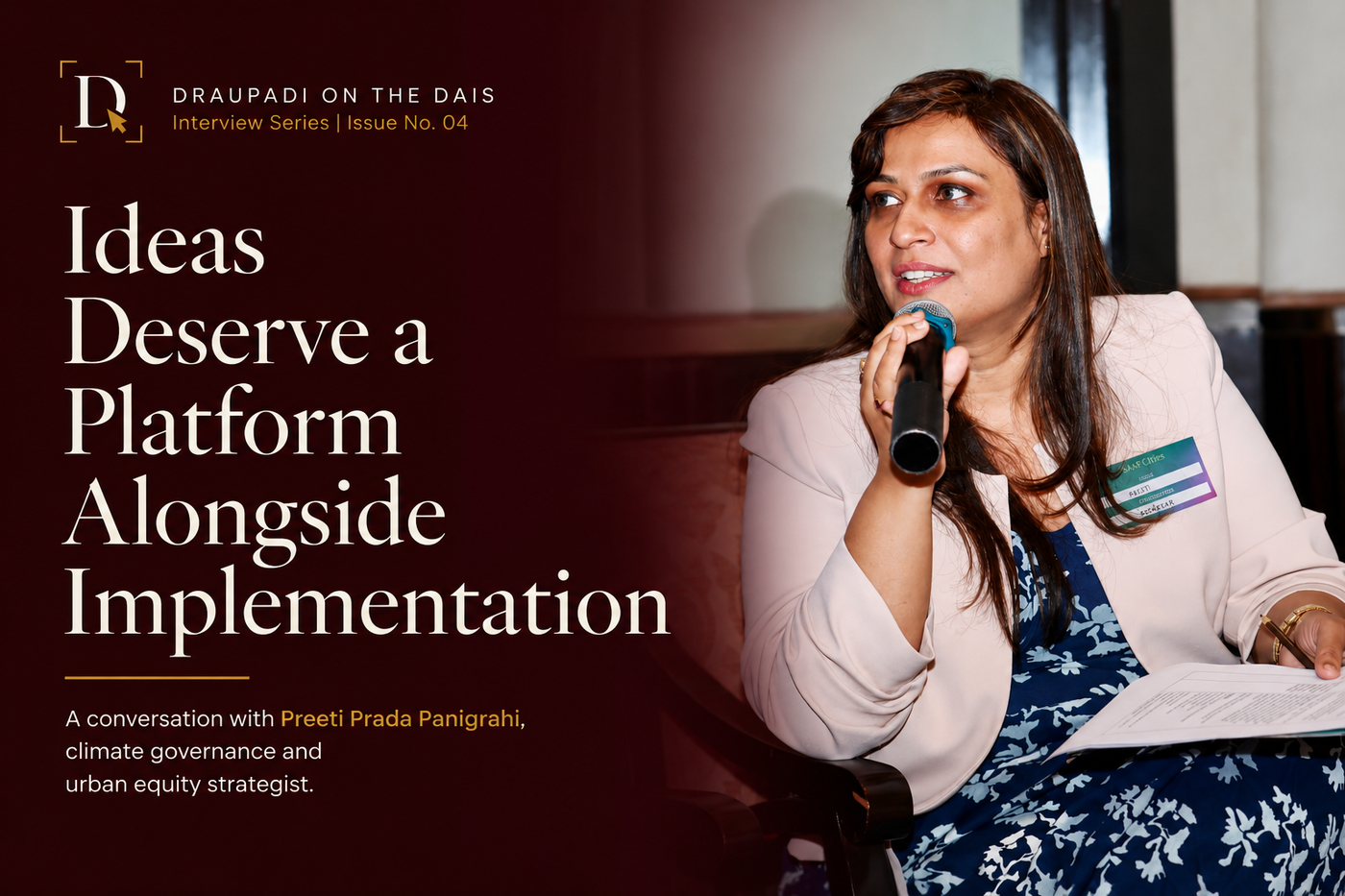
Preeti Prada Panigrahi is Director of Programs and Partnerships at Socratus Foundation for Collective Wisdom, India’s Country Representative to the International Play Association, and Founder of Reimagine Ideas Foundation. Her career spans the Bernard van Leer Foundation, Janaagraha’s JAGA Mission in Odisha, and over a decade of work across climate governance, urban equity, children’s rights, and circular economy policy.
The Conditions for Collaboration Before Collaboration Is Visible
Q1. There is usually work that goes on without a name on it, no metric attached, and that most people around you probably do not notice. What is the most important thing you do that fits that description?
I create the conditions for collaboration before collaboration is visible. Much of my work happens long before a partnership is announced or a policy is adopted. It involves building trust across institutions that don’t naturally work together, helping people see themselves as part of a shared system, and creating the confidence needed to move from fragmented efforts to collective action. Those conversations rarely appear in reports, but they are often what make transformation possible.
Stronger Institutions, Not Just Successful Projects
Q2. You are known for climate governance and urban equity, but there is often a project underneath the project, something you are building that does not have a job title attached to it. What is it?
I’m building the institutional infrastructure for systems change. Whether I’m working on waste, child-friendly cities, urban livelihoods, or climate resilience, the deeper project is always the same: creating platforms where governments, philanthropy, researchers, markets, and communities can learn, act, and invest together. My ambition is to leave behind stronger institutions, stronger networks, and stronger public imagination, not just successful projects.
Ideas Deserve a Platform Alongside Implementation
Q3. There is a kind of credibility that accumulates quietly, through work done over years, that still does not translate into the right invitations. Where do you think that gap lives?
I think the development sector often celebrates visibility more than systems contribution. Many practitioners spend years designing institutions, influencing policy, or enabling partnerships without being the public face of those efforts. Expertise isn’t always rewarded in proportion to impact. I’m increasingly investing in making my thinking as visible as my work, because ideas deserve a platform alongside implementation.
People Who Have Built Bridges, Not Simply Commented on Them
Q4. If you were briefing a conference organizer on how to actually find the best speaker for a topic rather than the most familiar one, what would you tell them?
Look beyond titles and organizational brands. Ask who has actually designed, tested, or influenced the systems you’re discussing. The best speakers combine lived implementation with strategic thinking; they can explain not just what worked, but why it worked, what failed, and what others can learn. Prioritize people who have built bridges across government, communities, research, and markets rather than those who simply comment on them.
Helping Diverse Stakeholders Arrive at a Shared Answer
Q5. Building a career in your field in India entails a specific set of invisible requirements that are not in any job description. What are some of them?
The most important skills are rarely technical. You need the patience to navigate institutions, the ability to build trust across political and organizational boundaries, and the resilience to keep moving when systems change takes years rather than months. I record myself as a Policy and Institutional Advisor, and, being part of that space, you also learn that influence comes less from having the right answer and more from helping diverse stakeholders arrive at a shared one. In India, progress often depends as much on relationships, credibility, and persistence as on expertise.
I Feel Peace in Pause
Q6. What does rest actually look like for you right now, not in theory but in practice?
Rest, for me, has become less about doing nothing and more about creating space to think. It’s reading without an agenda, spending uninterrupted time with my son, walking without my phone, or simply allowing myself not to solve a problem. After years of working in complex systems, I’ve realized that clarity often emerges not from working harder, but from creating moments of stillness. I feel peace in pause.
Ecosystem Leadership
Q7. If you could change one thing about how your field identifies, develops, or elevates expertise, what would it be?
I would value systems builders as much as subject specialists. The people who connect sectors, build partnerships, translate evidence into policy, and create the conditions for collective action are often invisible in our current models of leadership. Yet these are the people who make ambitious reforms possible. If we recognized and invested more intentionally in ecosystem leadership, we would strengthen not just individual organizations but the public systems they are trying to transform.
Preeti Prada Panigrahi is Director of Programs and Partnerships at Socratus Foundation for Collective Wisdom and Founder of Reimagine Ideas Foundation. This interview was conducted as part of the Draupadi on the Dais Interview Series.