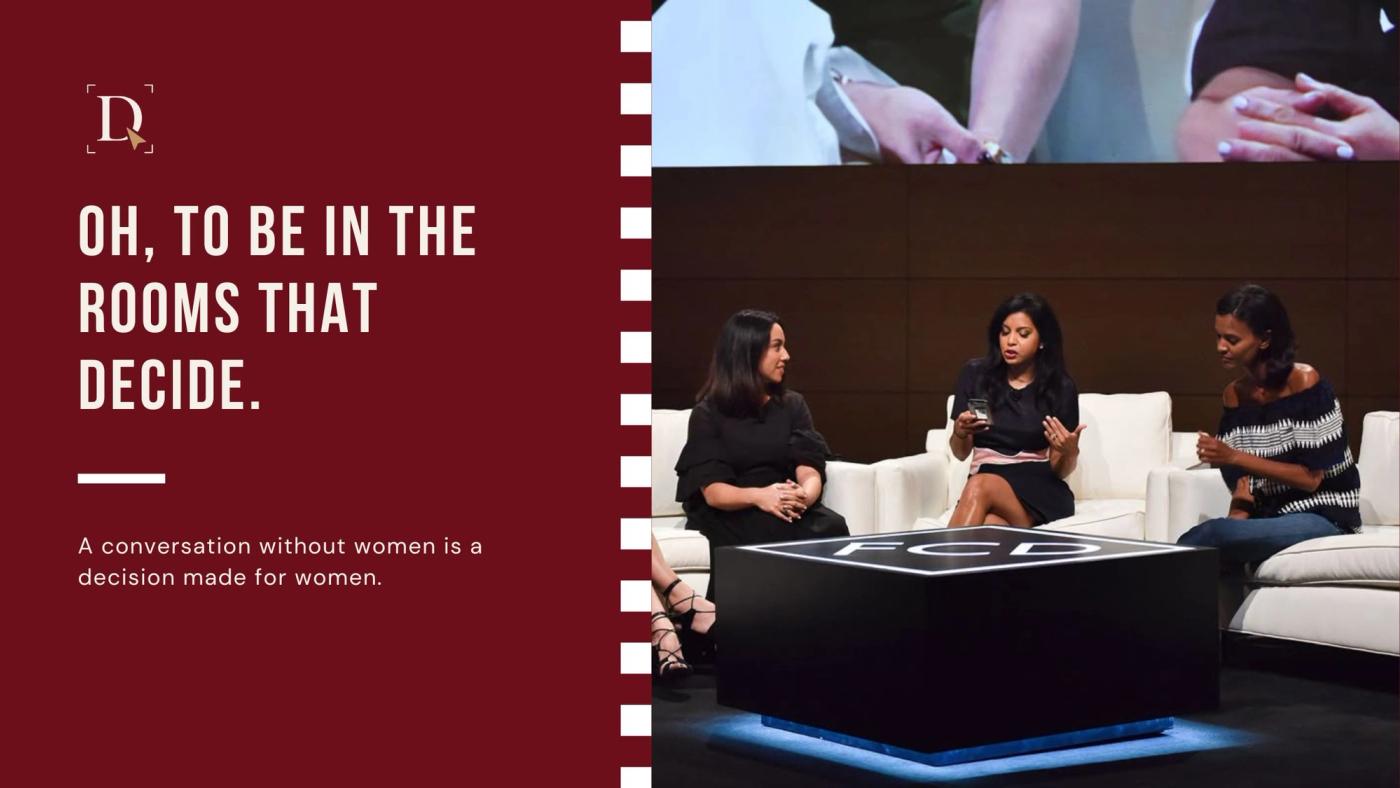
A conversation without women is a decision made for women.
There is a song in the musical Hamilton called The Room Where It Happens. It is about a backroom deal, a dinner between three men who walk out having quietly redrawn the political map of a country. The song is not really about the deal. It is about what it means to be in the room where the deal gets made. To be present at the moment a decision takes its first shape, before it becomes policy, before it becomes precedent, before it becomes the thing everyone else has to work around.
The song ends with a man who was not in that room, furious. Not because he disagreed with what was decided. Because he was not there when it was being decided.
That distinction is the whole argument.
I. This Week's Panel Is Next Year's Policy
Why do people attend panels?
People attend panels to learn something they couldn't Google, the unscripted opinion, the insider read on a situation, the thing someone says when they're not reading off a slide. They come for the room as much as the stage: the person sitting next to them, the conversation that spills into the corridor after, the proximity to people who are building things. And underneath both of those, honestly, they come to feel like they are inside something, part of a conversation that matters, not just watching it from outside.
You already know this, even if no one has said it plainly: the panels running this week are setting the vocabulary of their industries for the next several years.
What gets named in those conversations becomes the priority. What gets ignored stays invisible. Things that get normalised become the baseline everyone else inherits. This is not a metaphor. It is how institutional thinking actually moves. A roundtable produces a white paper. A white paper shapes a policy brief. A policy brief informs a board decision. A board decision lands on every person who works inside that structure, every client it serves, every market it operates in.

The women who should be in those rooms are often not in them. Not because they were not qualified. Not because they did not have something to say. Because when someone is building a speaker list or an advisory board, they search for who they already know. Convenience is the vice of man.
The women who have spent fifteen, twenty, thirty years building real expertise in sectors that matter are often nowhere in that search. Not because they are hiding. Because the system was not built to find them.
That is a structural failure. And structural failures do not fix themselves.
II. Your Angle of Vision Is Not a Bonus. It's the Point.
Being in a room is not simply a matter of occupying space. It is a matter of what you bring into it.
A perspective is not an opinion. It is a structure. Built over time, through the specific accumulation of what a person has experienced, survived, built, lost, and rebuilt. It is shaped by every decision made without you in the room. Every system you had to navigate that was not designed with you in mind. Every time you were the only one of your kind at a table, in a boardroom, on a stage, and had to decide whether to name that or let it pass.
In the Indian professional context, that calculus has its own particular weight. You have operated in rooms where ambition in a woman gets quietly coded as aggression. Where putting yourself forward invites the question of whether you are being too much. Where decades of expertise somehow still need to introduce themselves before they are taken seriously. You have navigated all of that and kept thinking, kept building, kept sharpening your point of view anyway.
When you walk into a conversation about your industry, you do not just bring your credentials. You bring the particular clarity that comes from having operated inside a system that was designed around a default you were not. That is not a soft asset. That is a precision instrument. It cuts through assumptions that people who fit the default never had reason to question.
Your identity is not incidental to your expertise. It is load-bearing.
III. Being Handed the Draft Is Not the Same as Writing It
Here is what happens when a woman is brought into a conversation after the shape of it has already been set.
Being handed a draft and called a collaborator. Asked for her perspective on a framework she had no hand in building. She is given the courtesy of input on something that has already, functionally, been decided. Her feedback gets noted. Sometimes it even gets incorporated. But the question the draft was answering was never hers to ask.
This matters because what gets said in a room must produce the logic of the decision. The assumptions it rests on. The problems it thinks it is solving. By the time a policy is written, a product is designed, a panel's framing is set, the real conversation is already over. What follows is execution, not debate.
Being consulted after is a courtesy. Being in the room is where the real power lies. The distance between them is exactly where the problem lives, and it is larger than it looks.
IV. The System Wasn't Built to Find You. Go In Anyway.
The system is broken. It defaults to the same faces, the same networks, the same panel circuit rotating through the same names. It was not designed to find you. It never really was.
But the system being broken is not a reason to wait outside the room. It is the reason getting into the room matters more than ever.
Every cause you have spent your career building. Every argument you have refined over decades of being underestimated. Every position you have earned the right to hold. It all lives or dies in the rooms you are not in. The decisions that will shape your industry, your sector, your field, the institutions that the next generation of women will walk into and either find changed or find exactly the same are being made in conversations you are absent from.
The system's failure to find you is real. It is also not the last word.
You have built a perspective that no one else has. You have earned a clarity that only comes from having navigated rooms not built for you, and coming out the other side still standing, still thinking, still sharp. That perspective belongs at the table. Not as a concession the room makes. As something the room cannot afford to be without.
The conversation happening today is the action happening tomorrow. The question is not whether the system will fix itself. It will not. The question is whether you claim your place in it anyway because everything you have fought for depends on what gets said in the room while you are not there.
Draupadi on the Dais connects accomplished Indian women experts with the panels, media, and platforms built to find them. Claim the Dais. Follow us at @decodingdraupadi.